Standardized, high-quality tools form the backbone of modern minimally invasive surgery (MIS). Surgeons rely heavily on these precise devices to navigate complex human anatomy through millimeter-sized incisions. Instrument quality directly influences operative time, surgeon fatigue, tissue trauma, and overall patient outcomes. Subpar tools routinely frustrate surgical teams and elevate clinical risks. We know how a dull pair of scissors or a leaky trocar can turn a routine gallbladder removal into a stressful ordeal. You will learn the core functional categories defining a standard surgical tray in this guide. We will explore how different handle designs and jaw configurations impact tissue handling. Selecting the right mix of reusable and single-use tools requires careful balancing. Clinical efficacy must closely align with hospital procurement budgets and operating room workflow compatibility.
Key Takeaways
A standard laparoscopic setup requires four functional categories: access, visualization, manipulation, and hemostasis.
The choice between traumatic and atraumatic graspers directly dictates tissue management safety during complex dissections.
Evaluating laparoscopic instruments requires a strict framework weighing ergonomic design against sterilization durability and cost-per-case.
Modern procurement favors vendors offering cross-specialty scalability and proven regulatory compliance (FDA/CE).
The Functional Framework: Categorizing Laparoscopic Instruments
Establishing a foundational blueprint for a general surgery tray ensures clinical standardization. Standard surgical training protocols teach residents to organize their setups systematically. A well-organized operating room relies on predictable tool availability. You must categorize your tools clearly based on their primary operative function.
We organize these essential devices into four core categories:
Access and Insufflation: Surgeons need these tools to create and maintain pneumoperitoneum safely before initiating dissection.
Visualization: Optics and camera systems drive operative field clarity, acting as the surgical team's eyes.
Manipulation and Dissection: These tools act as the "hands" of the surgeon. They include varied graspers, scissors, and blunt dissectors.
Hemostasis and Closure: Energy devices, clip appliers, and needle drivers manage bleeding and secure tissues before case completion.
A successful operating room setup minimizes mid-procedure instrument swapping. Swapping tools unnecessarily wastes valuable surgical time and disrupts operator focus. You achieve better flow by selecting versatile, multi-functional tools. High-quality laparoscopic instruments provide the reliability needed to maintain this smooth workflow. Surgeons prefer devices capable of performing multiple tasks, such as grasping and dissecting simultaneously. This strategic approach streamlines the tray and significantly reduces cognitive load during complex anatomical navigation.
Critical Access and Visualization Tools
Safe abdominal entry dictates the initial success of any minimally invasive procedure. Veress needles and trocars serve as the primary gateways into the patient. Historically, surgeons used bladed trocars to cut forcefully through fascial layers. Today, clinical preference heavily favors bladeless optical trocars. Bladeless designs part tissue fibers gently instead of slicing them. This crucial shift drastically reduces post-operative port-site herniation rates. It also minimizes devastating vascular injury risks during the dangerous blind insertion phase.
Seal integrity plays an equally critical role during the surgery. Trocars must maintain the pneumoperitoneum without continuous pressure drops. Leaky valves cause the operative workspace to collapse intermittently. A collapsing abdomen compromises visibility and directly endangers underlying organs. High-quality trocar seals grip passing instruments tightly to prevent continuous CO2 leakage.
The laparoscope acts as the definitive eye inside the patient. You must evaluate features directly linked to clinical outcomes. A standard 0-degree lens provides a straightforward, intuitive overview of the surgical field. However, complex cases often demand angled optics. A 30-degree or 45-degree angled lens proves essential for deep pelvic surgery. Angled lenses allow surgeons to look around anatomical corners during difficult biliary or colorectal dissections. Modern surgical towers now incorporate 4K resolution and 3D imaging capabilities. These advancements demand flawless optical pathways. Even microscopic debris baked onto a lens during sterilization will severely degrade a 4K image.
Implementing these optical systems carries inherent risks. Lens fogging constantly challenges operating room teams. Temperature differences between the cool operating room and the warm abdomen cause rapid condensation. Additionally, light transmission degrades gradually over repeated sterilization cycles. Hospitals must routinely assess fiber optic bundles for damage. Dim scopes compromise tissue recognition and unnecessarily delay surgical progress.
Precision Manipulation: Graspers, Dissectors, and Scissors
Tissue manipulation requires a delicate balance between secure traction and gentle handling. The choice between atraumatic and traumatic graspers dictates operative safety. You must outline a clear decision framework for your surgical teams.
Fenestrated atraumatic bowel graspers feature smooth, wide jaws. Surgeons use them to manipulate delicate intestines safely. The fenestrations distribute grip pressure evenly across the tissue. This intelligent design prevents accidental serosal tears or severe crushing injuries. Conversely, traumatic toothed graspers provide aggressive holding power. You reserve these heavy-duty tools for extracting tough fascia or grasping a chronically inflamed gallbladder. Using a toothed grasper on fragile bowel loops invites catastrophic perforations.
The Maryland dissector stands out as the ultimate workhorse of general surgery. It features a uniquely curved, tapered tip. This specific shape excels at blunt dissection and delicate vessel skeletonization. Surgeons slide the closed jaws into avascular planes. They then open the jaws to gently separate connective tissues without tearing. The gentle curvature also allows for precise hook-like maneuvering around critical structures like the common bile duct.
Laparoscopic scissors come in various designs, but curved Metzenbaum-style scissors dominate most standard trays. The curved blades conform naturally to anatomical contours. Straight shears remain available for simple suture cutting. However, scissors demand strict evaluation criteria. Blade sharpness longevity is absolutely vital. Dull scissors tear tissue instead of cutting it cleanly. Furthermore, scissor shafts require robust, flawless insulation. Intact insulation prevents stray electrosurgical burns when using monopolar energy near vital organs.
Ergonomics directly impact surgeon performance. Handle design choices range from traditional pistol grips to modern axial handles. Pistol grips mimic traditional open surgery tools, offering familiarity. Axial handles allow for continuous, comfortable rotation. Surgeons often operate in awkward postures for hours. A poorly designed handle forces the wrist into extreme ulnar deviation. Over time, this leads to chronic tendonitis. Premium tools balance the weight evenly between the tip and the handle. Rotational dials placed intuitively near the surgeon's index finger reduce hand fatigue. Prolonged cases require ergonomic excellence to prevent repetitive strain injuries among operators.
Hemostasis and Tissue Management Solutions
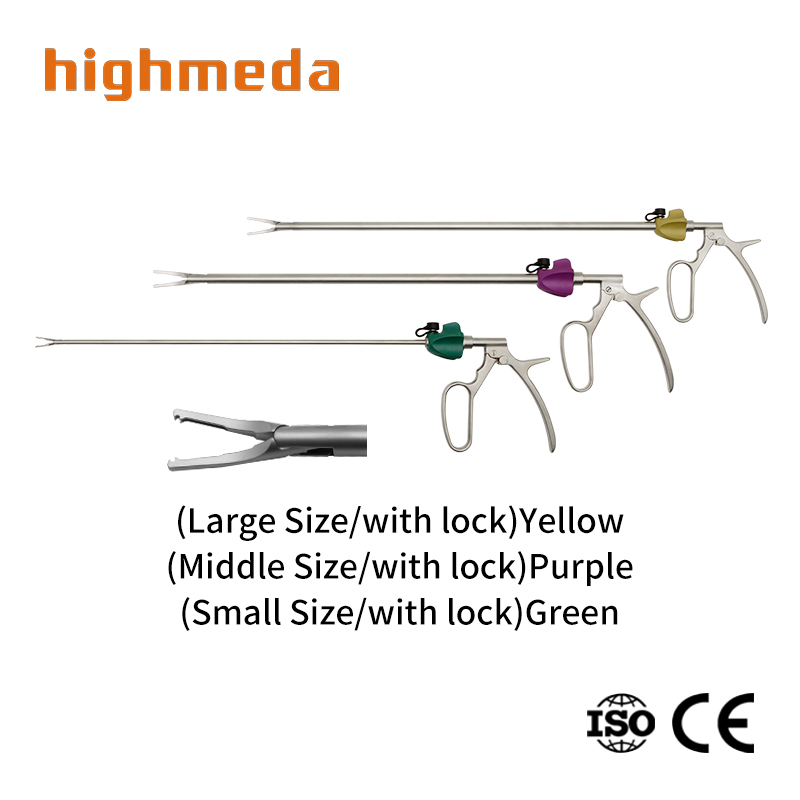
Controlling bleeding efficiently defines a safe laparoscopic procedure. Surgeons deploy various tools to achieve rapid hemostasis. Laparoscopic clip appliers remain indispensable for ligating vessels and sealing cystic ducts.
Material evaluation guides the choice of clips. Surgeons traditionally rely on titanium clips for their malleability and secure crimp. However, locking polymer clips offer distinct modern advantages. Polymer clips feature a mechanical latching mechanism for enhanced security on larger vessels. Furthermore, polymer clips do not cause significant imaging artifacts. This CT/MRI compatibility proves crucial for patients requiring post-operative oncological surveillance.
Energy devices form the core of electrosurgical tissue management. Surgeons must understand the risk mitigation strategies associated with these tools. Simple monopolar hooks and spatulas offer cost-effective, precise cutting. Yet, they carry a high risk of lateral thermal spread. Energy can travel through adjacent tissues, unintentionally damaging nearby bowel walls. Advanced bipolar sealers provide a safer alternative. They compress tissue and deliver controlled energy to seal vessels up to 7mm in diameter. Bipolar devices confine the thermal energy securely between their jaws. Regardless of the energy modality, intact instrument insulation remains non-negotiable.
Suturing tools, or needle holders, complete the tissue closure phase. Design variations include curved versus straight jaws. Curved jaws help rotate the needle fluidly through thick fascia. Straight jaws offer straightforward needle alignment. Many modern needle drivers feature internal self-righting mechanisms. These mechanisms automatically position the needle at the optimal driving angle. Intracorporeal knot tying presents a notoriously steep learning curve for surgical trainees. The right instrument choice significantly impacts adoption rates. Poorly designed needle drivers frustrate users and needlessly prolong closure times.
Table: Comparison of Energy Modalities in MIS
Modality Type
Primary Mechanism
Lateral Thermal Spread
Best Use Case
Monopolar (Hook/Spatula)
Current flows through patient to a return pad
Higher (Requires careful tissue isolation)
Precise dissection, scoring serosa
Advanced Bipolar Sealer
Current flows only between instrument jaws
Lower (Energy confined to grasped tissue)
Sealing large vessels and thick pedicles
Ultrasonic Shears
High-frequency mechanical vibration
Moderate (Friction-based heat generation)
Cutting and coagulating simultaneously
Strategic Evaluation Criteria for Hospital Procurement
Purchasing departments face complex decisions when upgrading surgical trays. They must evaluate laparoscopic instruments using strict, objective criteria. The debate between reusable and single-use tools continuously dominates modern procurement strategies.
We must weigh balanced claims objectively. Single-use tools guarantee predictable sharpness for every procedure. They ensure intact electrical insulation right out of the package. They also simplify infection control protocols. You never worry about a dull disposable scissor. However, single-use items generate substantial environmental waste. High-quality reusable instruments offer a significantly lower lifecycle cost. They require larger upfront capital investments but pay off predictably over hundreds of surgeries. Many hospitals now adopt hybrid models. These "reposable" systems feature a durable reusable handle paired with a disposable cutting tip. This hybrid approach balances clinical performance with waste reduction seamlessly.
Durability and sterilization compliance dictate a reusable tool's true clinical value. Manufacturers craft premium devices from medical-grade stainless steel and specialized plastics like PEEK. These robust materials must withstand intense, repeated autoclave cycles. Inferior metals warp under high heat. Cheap plastics degrade and crack, leading to hinge stiffening. Damaged insulation exposes patients to severe electrical burn risks.
Vendor shortlisting logic requires looking beyond the initial purchase price. You must assess how well the tools integrate into your existing operating room ecosystem. Consider the following crucial vendor requirements:
OR Integration: Tools must connect seamlessly with existing electrosurgical energy generators and trocar systems.
Warranty Terms: Comprehensive warranties protect the hospital's capital investment against premature mechanical failures.
Clinical Training Support: Vendors must provide robust on-site education for surgeons and sterile processing technicians.
Conclusion
The right surgical instruments successfully merge clinical precision with operational reliability. Surgeons need dependable tools to execute flawless dissections and secure hemostasis. Hospitals need durable assets to maintain healthy procurement budgets and efficient daily workflows. Choosing the optimal mix of reusable, single-use, and reposable devices elevates the entire surgical department.
We strongly advise procurement teams and lead surgeons to collaborate closely. Pilot new instruments in live clinical settings before committing to a hospital-wide contract. Real-world trials allow surgeons to assess tactile feedback, jaw strength, and ergonomic performance accurately. You simply cannot evaluate operational hand fatigue from a vendor catalog.
Take immediate action to optimize your operating rooms. Audit your current surgical trays to identify redundant or obsolete tools. Review your recent sterilization failure rates to pinpoint degrading instruments. Finally, consult with compliant, forward-thinking vendors to implement standardized, high-performance upgrades.
FAQ
Q: What is the standard lifespan of reusable laparoscopic instruments?
A: A high-quality reusable instrument typically lasts between 100 and 300 autoclave cycles. The exact lifespan depends heavily on maintenance variables. Rough handling, improper cleaning, and exposure to corrosive enzymatic solutions accelerate wear. Hospitals must perform routine visual inspections and rigorous insulation testing. Once a tool exhibits hinge stiffness or insulation micro-cracks, you must retire it immediately.
Q: How do you test the insulation of laparoscopic instruments?
A: Sterile processing departments use specialized electronic insulation testers. Technicians pass the instrument shaft through a charged ring or wand. If the insulation contains microscopic tears or pinholes, the tester detects escaping electrical current. The machine then triggers a loud audio-visual alarm. This vital step prevents stray capacitance and catastrophic patient burns during electrosurgery.
Q: What are the must-have laparoscopic instruments for a basic appendectomy or cholecystectomy?
A: A basic tray requires a highly streamlined, functional setup. You need a Maryland dissector for delicate tissue separation. Fenestrated atraumatic graspers are essential for holding the appendix or gallbladder securely. A monopolar hook cautery facilitates precise cutting and minor bleeding control. Finally, a reliable clip applier secures the cystic artery and duct safely.
Q: Are 5mm or 10mm instruments better for general surgery?
A: The current surgical trend strongly favors 5mm instruments. Smaller 5mm shafts minimize port-site trauma, reduce postoperative pain, and lower hernia risks. Modern manufacturing allows 5mm tools to deliver exceptional jaw strength and precision. Surgeons now reserve 10mm or 12mm ports almost exclusively for specialized tasks. You typically need larger ports only for endostaplers, clip appliers, and specimen extraction bags.