Picture this: you are deep into a Laparoscopic Common Bile Duct Exploration (LCBDE). The local anatomy is severely distorted by acute inflammation, and you urgently need to secure access to the common bile duct (CBD). Strictures and impacted stones demand absolute precision from your surgical team. In this high-stakes environment, choosing the wrong instrument risks severe ductal injury. Conversely, selecting the optimal tool ensures a smooth, safe, and atraumatic procedure.
This clinical guide breaks down the critical engineering and anatomical differences between straight and angled dilators. By understanding their distinct mechanical profiles and specific use cases, you can optimize your operating room's surgical toolkit, reduce procedure times, and significantly elevate patient safety.
Key Takeaways
Anatomical Alignment Dictates Choice: The specific angle at which the cystic duct joins the CBD determines your instrument. Preoperative imaging (like MRCP) serves as your definitive roadmap.
Straight Dilators Excel in Direct Approaches: Engineered for linear surgical pathways, these instruments provide the operator with uncompromised, direct tactile feedback during straightforward stricture dilation.
Angled Dilators Enhance Safety in Curves: Designed to navigate tortuous biliary anatomy and sharp junctions, angled tips drastically reduce the risk of iatrogenic mucosal perforation.
Instrument Synergy is Critical: The effectiveness of any single tool relies on the entire surgical setup. Facilities must evaluate metallurgical durability, ergonomic grip, and sterilization lifespan when sourcing inventory.
What is a Laparoscopic Bile Duct Dilator?
In the highly specialized realm of minimally invasive surgery, precision is non-negotiable. A biliary dilator is an essential surgical instrument meticulously engineered to safely and incrementally expand the diameter of the cystic duct or the CBD. During procedures such as LCBDE, surgeons rely heavily on these tools to create sufficient luminal space. This delicate tissue expansion is a mandatory prerequisite for subsequent steps, including the introduction of cholangiography catheters, the deployment of stone extraction baskets, or the secure placement of biliary stents.
Historically, open biliary surgery utilized large, rigid bougies that required significant manual force. However, the transition to minimally invasive techniques necessitated a complete mechanical redesign. Modern laparoscopic variants are engineered with extended, slender shafts—typically featuring a standard 330mm working length—designed to pass seamlessly through standard 5mm surgical trocars. The working tips of these instruments usually range from 3mm to 7mm in diameter.
In clinical practice, they are introduced sequentially. Starting with the smallest 3mm diameter, the surgeon gradually stretches the ductal tissue. The goal is to feel for the subtle tactile "give" of the fibrotic stricture without causing micro-tears to the fragile mucosal lining. The clinical significance of executing this step correctly cannot be overstated. Iatrogenic trauma to the biliary tract can lead to devastating bile leaks, postoperative strictures, or severe systemic infections. An efficient, atraumatic dilation process streamlines the workflow and minimizes the patient's exposure to anesthesia.
The Role of Biliary Anatomy in Instrument Selection
To fully grasp why distinct tip geometries exist, one must first examine the inherent variability of human biliary anatomy. The junction where the cystic duct merges with the common bile duct represents a formidable mechanical challenge. This intersection is rarely a uniform "T" shape. It can join at a sharp acute angle, run parallel to the CBD for several centimeters before merging, or even spiral anteriorly.
Complicating matters further are the spiral valves of Heister. These crescentic folds of mucous membrane project directly into the lumen of the cystic duct. While they regulate bile flow physiologically, they present a frustrating mechanical labyrinth during surgery. Surgeons often describe navigating these valves as threading a needle in the dark. The tortuous, undulating nature of these folds makes the insertion of any rigid, blunt instrument inherently difficult. A blunt tip can easily become caught on a mucosal fold, halting forward progress and increasing the risk of shearing.
Building upon this anatomical reality, forcing a linear instrument through a curved, folded pathway violates the basic principles of atraumatic surgery. This biological constraint directly influences how medical device manufacturers engineer specific variations in dilator tips, fueling the ongoing clinical evaluation of straight versus angled designs.
Straight Bile Duct Dilators: Features, Pros, and Cons
The straight bile duct dilator is characterized by its linear, unbending shaft that terminates in a smoothly tapered, atraumatic tip. The geometry of this instrument is engineered for pure axial force transmission. When the surgeon applies pressure to the external handle, that mechanical force is transmitted directly down the shaft to the tip in a straight vector.
Despite the inherently curved nature of the biliary tree, specific clinical scenarios demand a straight dilator. Surgeons frequently utilize them when preoperative cholangiography reveals a cystic duct that is unusually short, unusually wide, and aligns in a relatively linear fashion with the CBD. Furthermore, they are the absolute instrument of choice during a direct choledochotomy—an incision made directly into the CBD, bypassing the tortuous cystic duct entirely. In this head-on approach, the linear design is highly efficient.
The primary advantage of the straight design lies in its mechanical simplicity and direct sensory communication. Because the force vector is direct, surgeons experience highly accurate, uncompromised tactile feedback. You can feel exactly how much resistance the dense fibrotic tissue is offering. This immediate feedback loop allows the operator to gauge tissue compliance accurately and adjust applied pressure instantly.
In contrast, the main limitation of the straight design becomes glaringly apparent when it encounters sharp anatomical curves. If an operator attempts to advance a straight rigid tip through a severely angulated cystic duct, the tip will inevitably impact the lateral wall rather than following the lumen. Continuing to apply forward pressure in this scenario dramatically increases the risk of creating a "false tract"—a dangerous complication where the instrument dissects through the ductal wall layers.
Angled Bile Duct Dilators: The 45-Degree Advantage
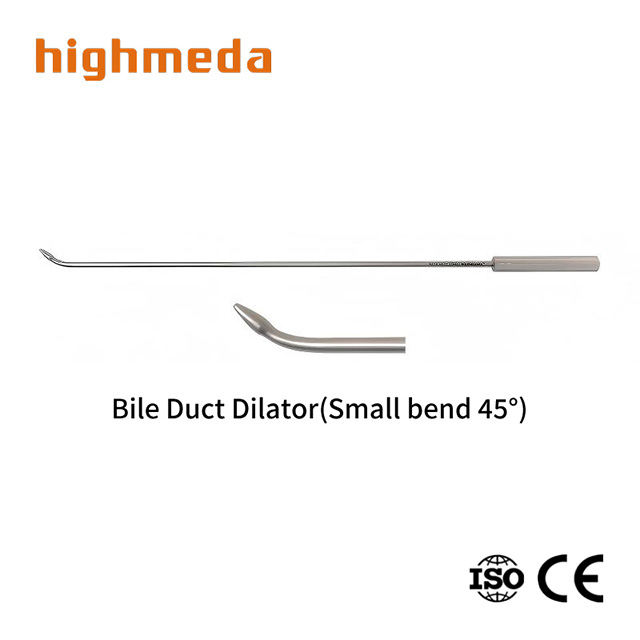
To address the anatomical hurdles posed by the valves of Heister and variable cystic-CBD junctions, biomedical engineers developed the angled dilator. The distal tip of this instrument features a deliberate, fixed curve rooted in biomimicry; it is intended to mimic the natural anatomical pathways of the biliary tree. By presenting a rounded leading edge to the duct wall rather than a pointed tip, the instrument is designed to glide smoothly over mucosal folds.
Through extensive clinical trials, the 45 degree bile duct dilator has emerged as the gold standard for angled biliary instrumentation. This specific angulation provides the optimal balance between forward maneuverability and lateral deflection. When the instrument approaches the cystic-CBD junction, the curve allows the tip to be steered seamlessly into the common bile duct. It directs the dilating force along the axis of the lumen, rather than perpendicularly into the opposite wall.
In complex surgical cases characterized by highly tortuous ducts or impacted stones, the angled dilator demonstrates clear superiority. When the tip encounters a sharp bend, the angled design allows it to deflect away from the duct wall and follow the path of least resistance. Consequently, this translates to a significantly lower risk of perforation compared to straight variants.
However, this enhanced safety profile demands a more nuanced surgical technique. Unlike straight dilators that rely on simple axial pushing, a 45-degree dilator requires a refined rotational technique. The surgeon must gently torque the handle, allowing the angled tip to "corkscrew" its way through the spiral valves. This maneuver requires specialized training and a heightened sense of spatial awareness.
Core Comparison: Straight vs. Angled Dilators
To help surgical teams and procurement officers make informed decisions, the following table breaks down the core operational differences between the two geometries:
Feature / Metric
Straight Dilator
45-Degree Angled Dilator
Optimal Anatomy
Short, wide, linear ducts; Direct CBD incision
Tortuous ducts; Valves of Heister; Sharp junctions
Tactile Feedback
Excellent (Direct axial transmission)
Good (Requires rotational interpretation)
Insertion Technique
Direct axial advancement (Pushing)
Rotational "corkscrew" maneuvering
Risk of False Tract
Higher in curved anatomy
Significantly lower
First-Pass Success Rate
Low in standard transcystic approaches
High in standard transcystic approaches
Industry Perspectives: The Shift Towards Atraumatic and Sustainable Instrumentation
Looking at the current trajectory of minimally invasive hepatobiliary surgery, clinical data reveals a distinct shift in how these tools are utilized and manufactured. Industry-wide, there is a growing consensus that angled dilators should be the default starting instrument for transcystic LCBDE, reserving straight dilators for specific anatomical exceptions or choledochotomies. This protocol shift is directly linked to a broader medical initiative to reduce iatrogenic bile duct injuries, which remain a costly and severe complication.
Furthermore, hospital procurement trends are rapidly moving away from single-use plastics. Driven by stringent hospital budgets and global sustainability initiatives, facilities are investing heavily in advanced metallurgical engineering. The focus is now on instruments that can endure aggressive autoclave sterilization cycles without structural degradation or surface pitting. High-tensile surgical steel is no longer a luxury; it is the baseline standard for modern operating rooms.
Actionable Selection Criteria for Procurement
For clinical directors and medical procurement officers, selecting the right surgical instruments goes far beyond tip geometry. To ensure maximum ROI and surgical efficacy, evaluate your inventory against these strict engineering standards:
Material Grade: Insist on premium 304 or 316L surgical stainless steel. This guarantees exceptional tensile strength, preventing the shaft from bowing under pressure, while providing superior corrosion resistance against biological fluids.
Dimensional Compatibility: The instrument must feature a true 5mm shaft to pass through standard trocars without damaging internal seals (maintaining pneumoperitoneum). A working length of 330mm is standard to accommodate diverse patient BMIs.
Ergonomic Control: Laparoscopic surgery is physically demanding. Look for handles with a knurled or heavily textured grip. This prevents slippage when surgical gloves become slick, ensuring absolute rotational control during delicate corkscrew maneuvers.
Reusability: Prioritize high-quality reusable laparoscopic instruments. The initial capital expenditure is quickly offset by the elimination of per-procedure disposable costs, drastically lowering the overall cost of ownership.
Integrating Dilators with Your Surgical Toolkit
A bile duct dilator is a crucial component, but it does not operate in isolation. Successful laparoscopic management of biliary diseases requires a comprehensive, integrated ecosystem of specialized tools.
Once the duct is adequately dilated, the surgeon may introduce cholangiography forceps to inject contrast dye, or insert stone extraction baskets and atraumatic graspers. Procurement officers must ensure that surgical trays are equipped with a full spectrum of complementary hepatobiliary laparoscopic instruments. Workflow is optimized only when surgeons have immediate, frictionless access to the right instrument at the exact moment it is required.
Conclusion
Mastering laparoscopic hepatobiliary surgery requires an intimate understanding of both human anatomy and the mechanical properties of your instruments. While straight dilators provide unparalleled direct tactile feedback and are highly effective for linear approaches, angled dilators offer superior maneuverability and a critical safety net when navigating tortuous ducts. Ultimately, surgical excellence is about equipping your operating room with a versatile array of high-quality tools.
Ready to upgrade your surgical trays? Ensure your surgical teams can adapt to unpredictable anatomical variations dynamically. Explore Highmeda's complete range of premium, surgical-grade biliary dilators and laparoscopic instruments at Highmeda Medical to find the exact specifications your operating room demands for safer, more efficient procedures.
FAQ: Frequently Asked Questions About Laparoscopic Bile Duct Dilators
What is the standard size range for a laparoscopic bile duct dilator?
Typically, these instruments range from 3mm to 7mm in diameter. During a procedure, surgeons utilize a technique called sequential dilation. They begin with the smallest diameter (usually 3mm) to gently stretch the tissue, gradually stepping up to larger sizes. This progressive approach safely expands the duct to accommodate stone extractors or stents without causing ischemic injury or tearing the delicate mucosal lining.
How do surgeons determine the correct starting size for a biliary dilator?
The starting size is heavily informed by preoperative imaging, such as Magnetic Resonance Cholangiopancreatography (MRCP) or intraoperative cholangiograms, which provide precise measurements of the duct's baseline diameter. Regardless of the imaging, best practice dictates starting with the smallest available dilator (typically 3mm) to assess tissue compliance before sequentially sizing up, thereby minimizing the risk of ductal trauma.
Can a straight bile duct dilator be used for a transcystic approach?
Yes, but its clinical application depends entirely on the patient's specific anatomy. A straight dilator is reserved for cases where preoperative imaging shows a cystic duct that is unusually straight, wide, and aligns naturally with the common bile duct. Because most cystic ducts feature tortuous curves, an angled dilator is widely considered the safer choice for standard transcystic approaches.
Are there specific contraindications for using rigid dilators in a transcystic approach?
Yes. Rigid sequential dilation is generally contraindicated if the cystic duct exhibits severe necrosis, intense acute inflammation that compromises wall integrity, or if the duct is so severely fibrotic and narrow that a soft hydrophilic guidewire cannot first be passed. In these high-risk scenarios, forcing a rigid dilator increases the risk of avulsion or perforation, and a choledochotomy or postoperative ERCP may be indicated instead.
How do you properly sterilize reusable biliary dilators?
High-quality reusable dilators are manufactured from durable surgical stainless steel, making them highly resilient. The process begins with immediate post-operative pre-cleaning using enzymatic detergents to break down bioburden. Following manual or ultrasonic cleaning, the instruments are sterilized using standard hospital autoclaving (steam sterilization). It is crucial to follow the temperature and pressure parameters recommended by the manufacturer to ensure complete sterility while preserving the instrument's structural lifespan.
What is the difference between a biliary dilator and a biliary bougie?
In modern surgery, these terms are frequently used interchangeably by medical staff. From a strict terminological standpoint, a "dilator" is a broader classification for any instrument designed to expand a cavity. A "bougie" specifically refers to a slender, cylindrical, and often flexible instrument used to gauge the size of a passageway or slowly widen a stricture. In laparoscopic hepatobiliary surgery, rigid stainless steel instruments used to expand the ducts are most accurately referred to as dilators.