In minimally invasive surgery, dissection precision correlates directly with patient safety. It also drives operating room efficiency. Suboptimal instrumentation often leads to jagged tissue margins. Poor tools might cause unintended thermal spread during energy application. They can also create severe hand fatigue for you during long operations. Procurement teams and clinical directors face a difficult balancing act. You must weigh surgical efficacy against strict budget constraints and regulatory compliance rules. This article provides an evidence-based framework for evaluating these essential tools. We cut through flashy marketing claims to focus on structural integrity. We prioritize reliable safety and consistent clinical performance. By the end of this guide, you will understand exactly how to evaluate and select the best instruments for your surgical team.
Key Takeaways
The primary advantage of curved profiles is improved tip visibility and the ability to contour around anatomical structures safely.
The choice between disposable and reusable models depends on a facility's sterilization infrastructure, volume, and budget structure (CapEx vs. OpEx).
Insulation integrity is a critical safety metric; microscopic degradation in reusable models can lead to dangerous stray electrosurgical burns.
Procurement decisions should prioritize vendor compliance (ISO 13485, FDA/CE), ergonomic flexibility, and real-world clinical trial feedback.
The Clinical Utility of Curved Tip Laparoscopic Scissors
Anatomical Contouring
The human body rarely features perfectly straight lines. Natural tissue planes curve around organs, blood vessels, and bile ducts. Standard straight blades often force surgeons into awkward angles. These awkward angles can easily puncture delicate structures. A curved profile perfectly aligns with these natural anatomical boundaries. Surgeons use curved laparoscopic scissors to dissect carefully behind critical vessels. The curvature acts as a physical guide. It gently pushes adjacent structures away from the cutting edge. This contouring ability minimizes collateral tissue damage. It allows you to maintain a clear margin of safety during complex tissue separation.
Visibility and Control
Straight blades frequently create a frustrating "blind spot" in the surgical field. The instrument shaft often blocks the camera's view of the blade tips. This issue becomes especially problematic during deep pelvic or bariatric procedures. Curved blades elegantly solve this visibility issue. The curve directs the cutting tip away from the central axis of the instrument shaft. This design ensures the tips remain clearly visible on the surgical monitor at all times. Using reliable curved tip laparoscopic scissors gives you enhanced depth perception. You gain superior control over every minute tissue transaction. Improved visibility directly translates to faster, safer operating times.
Dual Functionality
Versatility remains a vital characteristic of any modern surgical instrument. These tools perform exceptionally well in "cold" mechanical cutting. They snip delicate adhesions and divide tissue planes cleanly. However, they also serve as active electrodes for "hot" monopolar electrosurgical dissection. Most modern designs include a monopolar post near the handle. You attach a standard generator cable to this post. The surgeon can then apply cutting or coagulating current directly through the metal blades. This dual functionality reduces the need for constant instrument exchanges. The instrument functions as a versatile staple in every basic surgical tray.
Best Practice: Always keep the curved tip pointing toward the camera center. This maximizes visual feedback during tissue separation.
Common Mistake: Using excessive mechanical force instead of letting the electrosurgical current do the work. This dulls the blades prematurely.
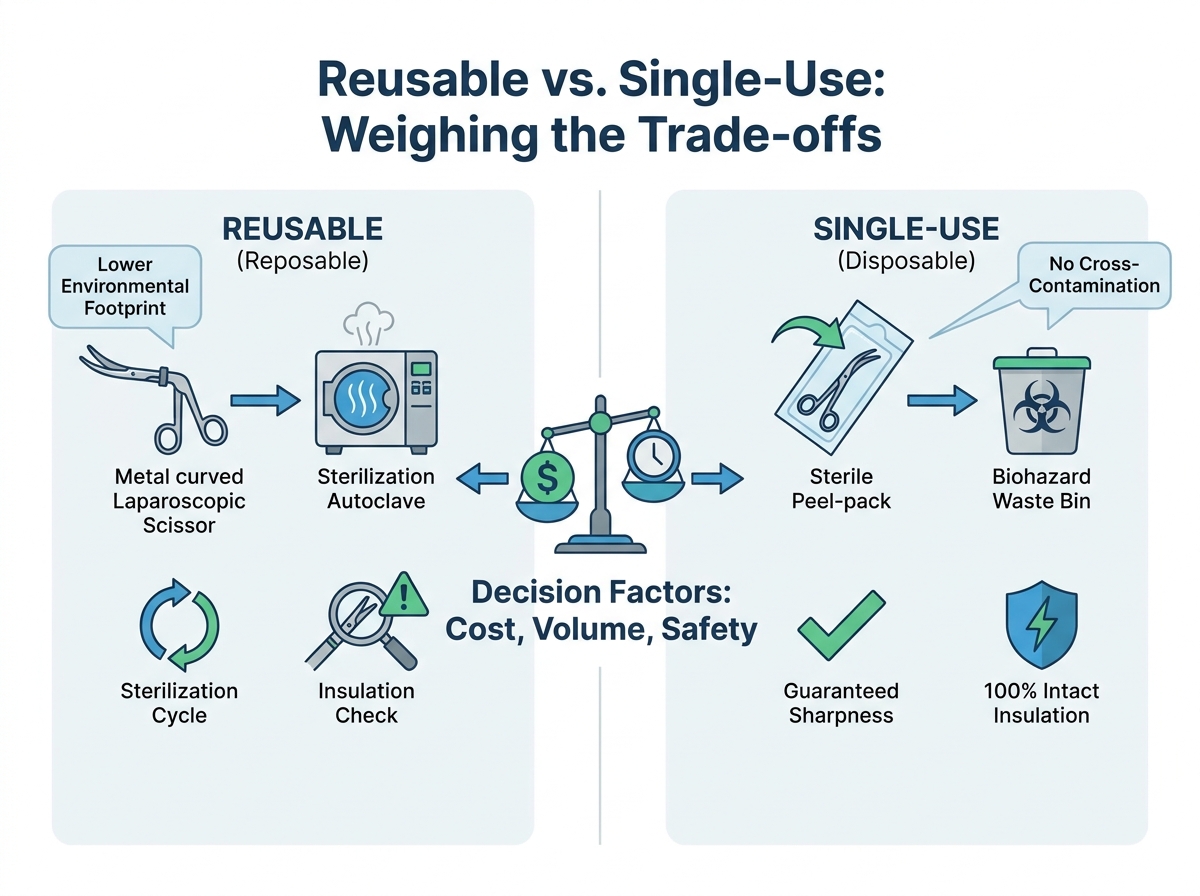
Reusable vs. Single-Use Laparoscopic Curved Scissors: Weighing the Trade-offs
Single-Use (Disposable) Advantages
Single-use instruments guarantee a pristine, factory-sharp edge for every single procedure. You never have to worry about dull blades crushing tissue instead of cutting it. Disposables also eliminate the severe risk of patient cross-contamination. They remove the heavy operational overhead required for hospital sterilization workflows. More importantly, single-use models provide 100% intact shaft insulation right out of the package. This guarantees maximum electrosurgical safety. The surgeon operates with complete confidence. They know no stray capacitance will leak through degraded insulation materials.
Reusable (Reposable) Advantages
Reusable instruments appeal to facilities prioritizing environmental sustainability. They generate significantly less medical waste per procedure. Over a long lifecycle, they reduce reliance on global supply chains for constant inventory replenishment. Veteran surgeons often prefer the tactile feel of reusable models. Manufacturers usually craft these instruments from heavier, premium-feeling metals. The handles feel substantial and balanced in the hand. The mechanical joint often provides a smoother, highly refined tactile feedback during delicate movements.
The Hybrid Approach
Many hospitals now adopt a modular hybrid system. This approach uses a heavy, reusable handle combined with disposable shaft and blade inserts. The hybrid model offers an excellent compromise. You get the premium ergonomic feel of a weighted handle. You also get a brand-new, perfectly sharp curved blade for every case. This system balances clinical sharpness with environmental sustainability. It reduces waste while maintaining excellent cutting performance.
Decision Matrix
You must assess your facility's central sterile processing capabilities. If your sterilization department is understaffed, single-use options prevent surgical delays. If your facility lacks significant inventory storage capacity, reusable tools reduce the need for constant box storage. Evaluate your specific clinical volumes before making a widespread procurement decision.
Comparison of Instrument Types
Feature
Single-Use (Disposable)
Reusable
Hybrid (Modular)
Blade Sharpness
Guaranteed sharp every time
Degrades over multiple uses
Guaranteed sharp every time
Insulation Safety
100% intact from factory
Requires regular defect testing
New shaft insulation each use
Environmental Impact
High medical waste
Low medical waste
Moderate medical waste
Sterilization Overhead
None
High (Cleaning and autoclaving)
Moderate (Handle only)
Core Evaluation Dimensions for Laparoscopic Dissection Scissors
Blade Geometry and Material Integrity
The manufacturing materials dictate the instrument's longevity and safety. You should look for high-grade surgical stainless steel. The 400 series stainless steel provides optimal hardness for edge retention. The 300 series provides excellent corrosion resistance for the outer shaft. Proper metallurgy prevents the blades from pitting during standard autoclave cycles. You must also evaluate the Metzenbaum-style curve carefully. A true Metzenbaum profile ensures a smooth, non-crushing tissue transaction. When you test laparoscopic dissection scissors, the blades should glide past each other effortlessly. They should cut cleanly all the way to the very tip.
Insulation Quality and Electrosurgical Safety
Insulation integrity is non-negotiable. You must assess the dielectric strength of the outer shaft coating. Shrink-wrapped polymers often degrade faster than molded polymer insulations. Highlight the critical risk of stray capacitance to your procurement team. Microscopic cracks in the insulation can cause severe thermal burns to non-target organs. These burns often go unnoticed during the surgery. You should demand transparent testing data from the manufacturer. They must prove the insulation's durability under repeated standard autoclave thermal cycles.
Ergonomics and Tactile Feedback
Surgeon comfort dictates surgical precision. Evaluate the various handle designs available on the market. Standard ring handles offer traditional control. Axial handles align the wrist vertically to reduce fatigue. Pistol grips provide significant mechanical advantage for thick tissue. You must check for a smooth 360-degree rotation knob on the shaft. This knob allows the surgeon to adjust the blade angle seamlessly using a single index finger. Smooth rotation reduces severe wrist strain. It prevents awkward arm contortions during long operations.
Best Practice: Always test the rotation knob while the instrument jaws are fully clamped shut. Poor quality instruments will bind or jam during this test.
Common Mistake: Ignoring handle size variations. A handle designed for a large glove size will cause severe cramping for a surgeon with smaller hands.
Implementation Risks and Reprocessing Realities
Sterilization Degradation
You must acknowledge the realistic lifespan of reusable tools. Nothing lasts forever in a surgical environment. Extreme thermal cycling inside hospital autoclaves inevitably breaks down the instrument. The intense heat degrades the critical joint lubrication. It hardens the rubberized insulation wrapping, making it brittle. Eventually, the blades lose their alignment. The scissors begin to tear tissue rather than slice it cleanly. You need strict replacement protocols to manage this inevitable degradation.
Maintenance and Inspection Bottlenecks
Reusable instruments require rigorous post-sterilization inspection workflows. Your sterile processing department must invest in proper testing equipment. They need high-voltage insulation defect detectors (porosity testers). These devices scan the shaft for microscopic cracks invisible to the naked eye. Staff must also use specific sharpness testing materials. Red latex bands mimic tissue resistance for accurate sharpness testing. These manual inspections create massive bottlenecks before the instruments can return to the operating room.
Compatibility Risks
Never assume universal compatibility across different brands. You must strictly verify jaw dimensions and outer shaft diameters. A standard shaft diameter measures exactly 5mm. If the insulation expands slightly during sterilization, the instrument will stick inside the trocar seal. Shaft lengths also vary significantly. A 33cm length suits standard general surgery. However, you need a 45cm length for deep bariatric procedures. Your newly procured laparoscopic curved scissors must seamlessly integrate with your existing trocars and monopolar generator cables.
Shortlisting Suppliers: A Procurement Checklist
Regulatory Compliance
Medical device procurement requires strict adherence to global safety standards. You must verify the manufacturer's baseline quality management systems. Look for an active ISO 13485 certification. This certification proves the vendor follows strict medical manufacturing protocols. You must also require proper regional clearances. In the United States, demand an FDA 510(k) clearance letter. In Europe, verify the CE marking. Never compromise on these baseline regulatory standards. Uncertified instruments introduce severe liability risks to your hospital.
Clinical Evaluation (Trials)
Do not buy surgical instruments directly from a paper catalog. You must mandate a comprehensive clinical trial period. Objective surgeon feedback remains your most valuable evaluation metric. Ask the surgical staff to evaluate the tactile feel of the handles. Have them test the blade sharpness during dense tissue dissection. They must also verify the rotational smoothness of the index knob. This clinical feedback is completely non-negotiable. If the surgeons reject the instrument during the trial, you should immediately disqualify that specific vendor.
Supply Chain Reliability
A brilliant surgical instrument offers zero value if it sits on permanent backorder. You must evaluate the vendor's historical supply chain reliability. Ask for data regarding their standard shipping lead times. Investigate their recent backorder history. You should also test their responsiveness to warranty claims. Do they offer local instrument sharpening and repair services? A responsive vendor acts as a true partner for your facility. They help prevent critical instrument shortages during busy surgical schedules.
Request regulatory documentation (ISO, FDA, CE).
Distribute sample instruments to multiple surgical specialties for a two-week trial.
Collect standardized feedback forms focusing on ergonomics and sharpness.
Audit the vendor's distribution network and average delivery timelines.
Conclusion
Choosing the correct dissection instruments requires careful consideration. You must balance mechanical precision, patient safety, and facility workflow compatibility. High-quality curved blades provide unmatched anatomical contouring and visibility. Reliable insulation prevents catastrophic electrosurgical injuries. Your facility must decide between single-use, reusable, or hybrid models based on your unique operational capabilities.
We advise decision-makers to assemble a dedicated cross-functional evaluation team. This team should include lead surgeons, sterile processing managers, and procurement officers. A collaborative approach ensures you meet all clinical and operational requirements. It prevents unilateral decisions that might disrupt surgical workflows.
Begin your evaluation process today. Reach out to reputable manufacturers directly. Request their detailed product specifications. Ask for physical clinical samples to distribute among your staff. By taking a methodical, evidence-based approach, you will secure the best possible instrumentation for your surgical teams and patients.
FAQ
Q: What is the standard length of curved laparoscopic scissors?
A: The standard shaft length typically measures 330mm. This length works perfectly for most general surgery and gynecological procedures. Manufacturers also offer extended 450mm options specifically designed for bariatric procedures. The standard outer shaft diameter remains 5mm to fit universally through most surgical trocars.
Q: Can curved laparoscopic scissors be used for coagulation?
A: Yes. When equipped with a monopolar post near the handle, they function as an active electrode. They can dissect and coagulate tissue simultaneously. You must ensure the generator is set correctly and the shaft insulation is fully intact to prevent stray thermal burns.
Q: How many times can reusable laparoscopic scissors be sterilized?
A: There is no infinite lifespan for these tools. The exact number depends strictly on the manufacturer's Instructions for Use (IFU) and clinical inspection passing rates. Thermal cycling eventually breaks down insulation and dulls the blades. Mandatory tracking and routine defect testing dictate when to retire the instrument.
Q: What is the difference between standard curved scissors and Metzenbaum laparoscopic scissors?
A: Metzenbaum scissors feature a specific, much more delicate blade profile. Manufacturers design this subtle curve strictly for the precise dissection of soft, delicate tissues. You should never use Metzenbaum blades for cutting tough materials like heavy sutures or thick fascia, as this will instantly ruin the fine edges.