In minimally invasive surgery, your choice of cutting instruments directly impacts tissue trauma, procedural speed, and surgeon fatigue. Getting this right is crucial for operative success. Poorly selected tools increase surgical time and cause unnecessary hand strain. Procurement teams and clinical directors often face conflicting claims regarding the superiority of single-action versus double-action instruments. The decision isn't about finding a universally "better" tool to stock across all departments. Instead, it involves matching the mechanical action to specific surgical requirements and facility budgets. Making the wrong choice can lead to instrument failure or wasted hospital resources. We provide a clinical and procurement-focused comparison to help surgical facilities evaluate, shortlist, and standardize their instrument trays based on verifiable performance data. You will discover exactly how different mechanisms affect tactile feedback and tissue manipulation. We will also guide you through a step-by-step evaluation process. You can use these insights to make confident, evidence-based purchasing decisions for your operating rooms.
Key Takeaways
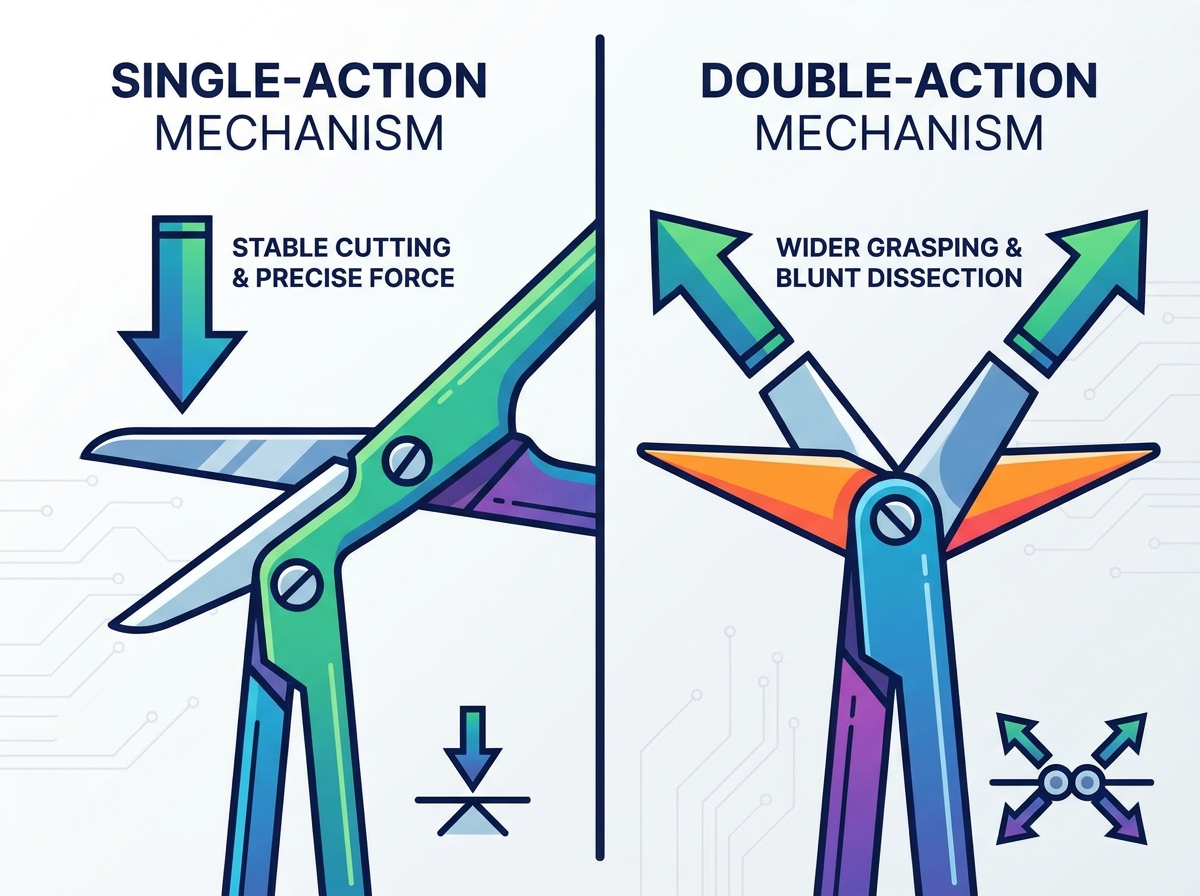
Mechanical Difference: Single-action scissors offer higher shearing force and stability at the tip, while double-action scissors provide a wider jaw aperture for grasping and blunt dissection.
Clinical Application: Single-action is optimal for precise, dense tissue cutting; double-action excels in general transection and rapid tissue manipulation.
Durability vs. Utility: Single-action designs typically withstand more sterilization cycles due to fewer moving parts, offering a lower total cost of ownership (TCO) for reusable inventories.
Evaluation Focus: The final choice should rely on subjective surgeon ergonomic feedback combined with objective sharpness retention data.
1. Understanding the Laparoscopic Scissors Mechanism
Defining the Baseline
Understanding how instrument design dictates force transmission is essential. Surgeons rely on this energy transmission from the handle down to the distal tip. A surgeon squeezes the ergonomic handle rings. This action pushes or pulls an internal rod down the insulated shaft. The rod then engages the cutting jaws. This sequence translates manual grip effort into actual shearing force. Different mechanical designs change how efficiently this force travels. You must rigorously evaluate this energy transfer when selecting surgical tools. It dictates cutting power, tactile sensitivity, and overall instrument longevity. Evaluating this baseline helps procurement teams distinguish high-quality tools from inferior alternatives.
The Laparoscopic Scissor Jaw Action
The internal mechanics split into two primary categories. The laparoscopic scissor jaw action defines how the blades physically engage target tissue.
Single-Action: This design features one stationary blade and one mobile blade. Force concentrates intensely against the fixed axis. It effectively turns the stationary blade into an immovable anvil.
Double-Action: Here, both blades pivot simultaneously from a central pin. This approach distributes mechanical stress across two moving hinges. The blades open wider but inherently split the driving force between them.
Impact on Tactile Feedback
Surgeons heavily depend on tactile feedback during closed abdominal procedures. They cannot touch the tissue directly with their hands. The laparoscopic scissors mechanism significantly alters this critical sensory input. A single moving blade offers highly rigid resistance. It transmits dense tissue vibrations straight up the metal shaft into the handle. This helps you feel exactly what you are cutting. It helps surgeons detect hidden blood vessels before transection. Dual moving blades absorb some of this vibration through their twin hinges. They provide a smoother sweeping motion but slightly mask subtle tissue densities.
2. Single Action Laparoscopic Scissors: Pros, Cons, and Use Cases
Clinical Advantages
Single action laparoscopic scissors provide distinct benefits for delicate operations. They excel in micro-dissection tasks. The stationary blade acts as a rigid anchor inside the abdomen. Surgeons experience superior stability when navigating tight anatomical spaces.
Another major advantage is the concentrated shearing force. Force directs fully into one mobile cutting edge. This setup effortlessly slices through calcified or highly dense tissues. It prevents the blades from splaying apart under extreme pressure.
Furthermore, the fixed lower blade serves a brilliant dual purpose. It acts as a stable sliding platform. Surgeons slide it smoothly under tissues for precise vessel isolation. This safely protects underlying anatomical structures during complex dissections.
Implementation Risks & Limitations
Despite their extreme precision, these tools have specific limitations. The stationary blade restricts the maximum jaw opening width. A narrower jaw aperture restricts the volume of tissue you can safely engage at once. Surgeons must take smaller, more frequent tissue bites. This can slightly extend the duration of tissue transection.
Improper technique can also cause frustrating operative issues. Cutting at an incorrect angle might trigger "tissue push-out." The targeted tissue slips forward out of the jaws instead of cleanly dividing. You must ensure surgeons align the fixed blade properly to avoid this complication.
Best-Fit Procedures
These tools shine brightly in highly precise, targeted resections. We strongly recommend them for isolating delicate neurovascular bundles. They also perform exceptionally well in specific gynecological or urological dissections. Any procedure demanding millimeter precision heavily benefits from this single-pivot design.
Best Practices & Common Mistakes:
Best Practice: Always position the stationary blade beneath the target tissue before closing the handle. This maximizes control and visibility.
Common Mistake: Attempting to grasp massive tissue bundles. This overstresses the single mobile joint and dulls the blade prematurely.
3. Double Action Laparoscopic Scissors: Pros, Cons, and Use Cases
Clinical Advantages
Double action laparoscopic scissors bring unique versatility to the modern operating room. Both blades open simultaneously upon handle actuation. This creates a significantly wider jaw aperture. This broad opening allows for highly effective tissue grasping. Surgeons can confidently manipulate larger tissue bundles before committing to a cut.
They are also highly efficient for blunt dissection techniques. A surgeon inserts closed tips into a tissue plane. When they open the handle, both blades push outward. This bilateral movement spreads tissues apart cleanly and symmetrically. It minimizes unintended trauma to surrounding delicate structures.
Additionally, the bilateral pivot mimics conventional open-surgery scissors perfectly. This provides a familiar, natural "traditional scissor" feel. It significantly reduces the learning curve for newer surgeons transitioning into minimally invasive techniques.
Implementation Risks & Limitations
The complex dual-joint mechanism introduces real durability concerns. Moving parts inherently carry a higher risk of mechanical fatigue. Repeated autoclave sterilization cycles can cause severe joint loosening. A loose central joint diminishes cutting efficiency over time. It eventually causes the blades to tear tissue rather than cut it cleanly.
These scissors also produce a slightly lower terminal shearing force. The mechanical effort splits evenly between two moving components. They might struggle slightly when encountering heavily calcified structures. Surgeons often notice a difference in cutting power compared to single-action alternatives.
Best-Fit Procedures
We consider these tools the reliable workhorses of high-volume general surgeries. They are ideal for routine laparoscopic appendectomies. They also excel during standard cholecystectomies. In these specific procedures, surgeons prioritize rapid tissue division and extensive blunt dissection over microscopic cutting precision.
Best Practices & Common Mistakes:
Best Practice: Utilize the wide opening to spread fascial layers gently before activating any electrosurgical current.
Common Mistake: Ignoring slight lateral play in the joint. If the blades wobble, you must pull the instrument from circulation immediately to prevent surgical complications.
4. Evaluation Dimensions: Bridging Clinical Needs and Procurement Goals
Feature-to-Outcome Mapping
Procurement decisions require clear, objective metrics. You must map physical tool features directly to expected surgical outcomes. Relying entirely on brand reputation often leads to budget waste.
Sharpness Retention: This measures exactly how many cuts a blade sustains before microscopic burrs form. Dull blades tear tissue instead of cutting it smoothly. This increases patient healing time. You should always ask manufacturers for verifiable Rockwell hardness ratings and wear-testing data.
Ergonomics: Subjective handle evaluation is equally critical for surgical success. You must observe how jaw action correlates to surgeon hand fatigue. Three-hour procedures easily amplify minor ergonomic flaws into severe hand cramping. Proper handle design prevents long-term joint strain for your valuable surgical staff.
Sterilization and Compliance Realities
Hospital sterilization protocols are notoriously brutal on surgical instruments. High-pressure steam, enzymatic cleaners, and ultrasonic baths degrade metals rapidly. You must evaluate hinge integrity under standard autoclave conditions. Single-action joints have fewer moving surfaces exposed directly to steam. They generally resist internal corrosion and pitting better. Dual-action mechanisms contain intricate, tight crevices. These tiny microscopic spaces harbor moisture. They invite faster metal degradation and increase the risk of retained bio-burden.
Cost vs. Longevity
Facility budgets demand careful scrutiny of instrument replacement frequencies. Reusable dual-hinge instruments are inherently prone to accelerated joint wear. They require more frequent professional repairs. Often, they demand complete premature replacements. Conversely, instruments utilizing a single-pivot system enjoy a predictably longer operational lifespan. You must balance the initial purchase price against this historical replacement frequency. A cheaper upfront cost often masks significantly higher long-term replacement expenses. We strongly recommend tracking inventory lifecycle data closely through your asset management software.
Table 1: Mechanism Feature Comparison
Evaluation Metric
Single-Action Design
Double-Action Design
Tissue Spreading (Blunt Dissection)
Asymmetrical, moderate efficiency
Symmetrical, highly efficient
Shearing Force Concentration
Maximum intensity at distal tip
Distributed evenly across both blades
Sterilization Durability
High (fewer exposed moving parts)
Moderate (joint wear susceptible)
Surgeon Learning Curve
Requires careful blade angle adjustment
Intuitive, resembles traditional scissors
5. Shortlisting Logic and Next Steps for Your Facility
Standardization vs. Specialization
Inventory management requires strategic forward planning. You face a choice between stocking both mechanisms or standardizing purely on one. Stocking both provides specialized tools for every possible scenario. However, it severely complicates inventory tracking. Standardizing on one primary mechanism streamlines your sterile tray setups. It also dramatically reduces training variables for sterile processing staff. You must carefully assess your surgical volume diversity before deciding. Facilities focusing heavily on micro-surgery might choose one path, while general surgery centers choose another.
The Trial Protocol
A structured trial prevents biased purchasing habits. We advise setting up a blind or objective trial involving your core surgical staff. Use this straightforward protocol to ensure accurate results:
Provide surgeons with anonymized laparoscopic scissors samples of different internal designs.
Record their immediate feedback on tactile response and cutting efficiency during simulated tasks.
Test the instruments repeatedly on synthetic tissue blocks to ensure consistent tissue resistance.
Route all trial instruments through the sterile processing department. Have technicians evaluate the ease of cleaning and flushing.
This hands-on data quickly reveals the true clinical value of each tool.
Vendor Vetting
Do not accept glossy marketing brochures at face value. You must ask manufacturers targeted, highly technical questions. Request exact details regarding the metal grade. Premium surgical stainless steel composition dictates rust resistance and edge retention. Ask for explicit warranties covering hinge mechanisms against premature failure. Demand verifiable durability testing data conforming to ISO or ASTM standards. Reliable vendors gladly supply independent lab reports showing exact cycle-to-failure rates. They hide nothing from informed buyers.
Actionable Next Step
Move beyond theoretical product comparisons. Your immediate next step is requesting functional, sterile samples from certified vendors. Establish a strictly defined clinical trial period for your team. A two-week evaluation window usually generates enough reliable data for a confident decision. Gather feedback systematically and compare it against your capital equipment budget.
Conclusion
Both mechanisms serve critical, distinct roles in the modern operating room. They cater to very different surgical demands and anatomical challenges. Do not rely solely on manufacturer marketing when outfitting your facility. Base your procurement decisions on measurable procedural volume, objective durability data, and aligned surgeon feedback.
Key Takeaways for Next Steps:
Consult your lead surgeons immediately to identify current instrument pain points.
Review your historical replacement data to spot premature joint failure trends.
Contact reliable suppliers to structure a hands-on, blinded evaluation protocol.
Prioritize sharpness retention data alongside subjective ergonomic feedback.
You must balance clinical performance against real-world sterilization realities. Taking these proactive steps ensures your facility invests in tools maximizing both surgical success and budget efficiency.
FAQ
Q: Does the laparoscopic scissor jaw action affect the ease of instrument cleaning?
A: Yes, double-action joints harbor more bio-burden. The dual-hinge assembly creates microscopic crevices. These spaces trap blood and tissue debris during surgery. They require much more meticulous flushing protocols in the sterile processing department than single-action joints. Properly cleaning single-action hinges is generally faster and significantly more straightforward.
Q: Are double action laparoscopic scissors better for blunt dissection?
A: Generally, yes. The bilateral movement allows for symmetrical tissue spreading. When a surgeon inserts closed tips into a tissue plane and opens the handles, both blades push outward equally. This action separates delicate tissues safely and cleanly, making it highly effective for rapid blunt dissection tasks.
Q: Which mechanism is preferred for disposable laparoscopic scissors?
A: Disposable instruments frequently utilize double-action mechanisms. Long-term hinge durability is the primary drawback of a double-action design. Because single-use tools are discarded immediately after the procedure, mechanical fatigue and autoclave degradation are not factors. Manufacturers provide ergonomic dual-blade benefits without worrying about long-term joint wear.
Q: How does the laparoscopic scissors mechanism impact pricing?
A: Double-action designs often carry a slightly higher manufacturing cost. Assembling a complex dual-hinge requires more precise machining and labor. However, this base cost difference is rarely a major barrier for facilities. Bulk purchasing contracts and vendor negotiations usually normalize the unit price difference for the end buyer.